
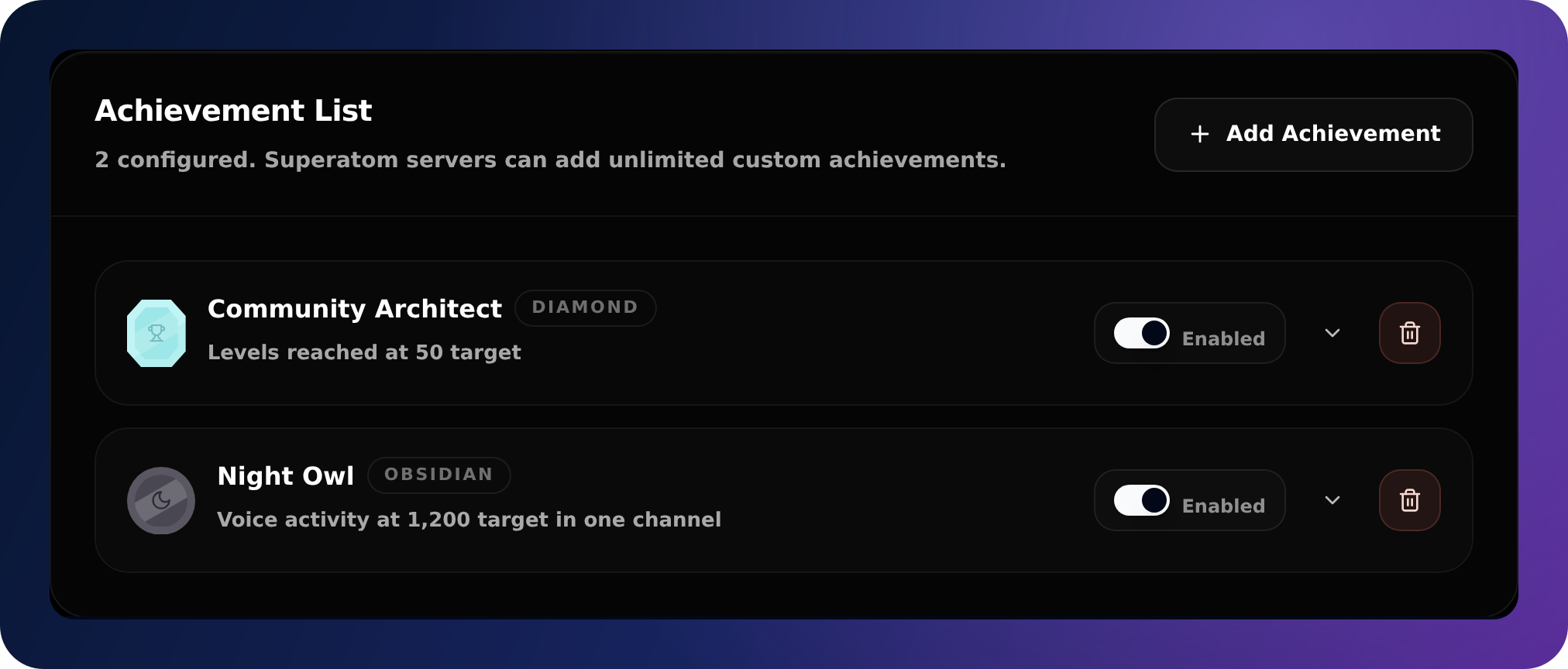
In brief: Adding achievements is a design workflow, not a switch. Define the behavior, choose a trigger that measures it fairly, make the achievement understandable, test the complete unlock, and then launch a small collection.
1. Write the community goal before opening settings
Name the contribution you want to recognize in a sentence. “We want members to help one another solve problems” is a goal; “50 messages” is only a measurement. If you cannot explain the goal, members will optimize the number instead of the behavior.
- One early milestone for newcomers.
- One contribution milestone tied to the community’s purpose.
- One long-term marker.
- One optional event or staff-recognized card.
2. Match the goal to one task—or several
Atom can track messages, eligible voice minutes, reactions, XP, levels, trivia, crates, a gained role, and staff assignment. Message, voice, and reaction tasks can be scoped to a channel. An achievement may require several tasks, and it unlocks only after every task is complete.
Collection milestones can require a selected set of achievements or any configured number of completed achievements. Use the selected option for a deliberate sequence such as finishing every onboarding card; use the numeric option for a broad collector milestone. Do not automate a subjective judgment—a “great project” card is stronger as a manager-assigned achievement with a documented staff standard.
3. Design a card members can understand at a glance
Use a short name, an explicit description, and a visual treatment that matches the accomplishment. Atom’s preset plaques combine a tier, shape, treatment, and icon; eligible Superatom servers can upload a custom plaque. Put the achievement condition in words on the card rather than making members decode a private staff rule.
4. Decide what happens on unlock
Recognition is the baseline: a card and an announcement create a durable public moment without inflating the economy. In the Rewards section, select a reward first and configure the related XP amount, level amount, or roles. Add more distinct reward types as needed; the same type cannot be selected twice. Green Add labels increase or grant something, while red Remove labels deduct XP or levels or take away roles.
Avoid giving a new role for every small counter. Save access, responsibility, or status roles for thresholds that genuinely justify them. Role delivery still depends on Discord’s role hierarchy and permissions.
roles, perks, and reward ideas · Discord role hierarchy and permissions documentation
5. Test, announce, and improve
Use a staff account to cross each test threshold. Verify the progress shown by /achievements, the card, the announcement channel, and the optional reward. Test the negative case too: excluded channels, ineligible voice states, and roles above the bot should not silently create a broken promise.
Launch with a short explanation: what achievements recognize, where members can view progress, and which first cards are available. Review unlock rates in the first weeks. A card that everyone earns immediately is usually an onboarding signal; a card nobody earns usually has a design or configuration problem.
Atom’s configuration reference · the complete achievement-system guide
Build a collection with intent