
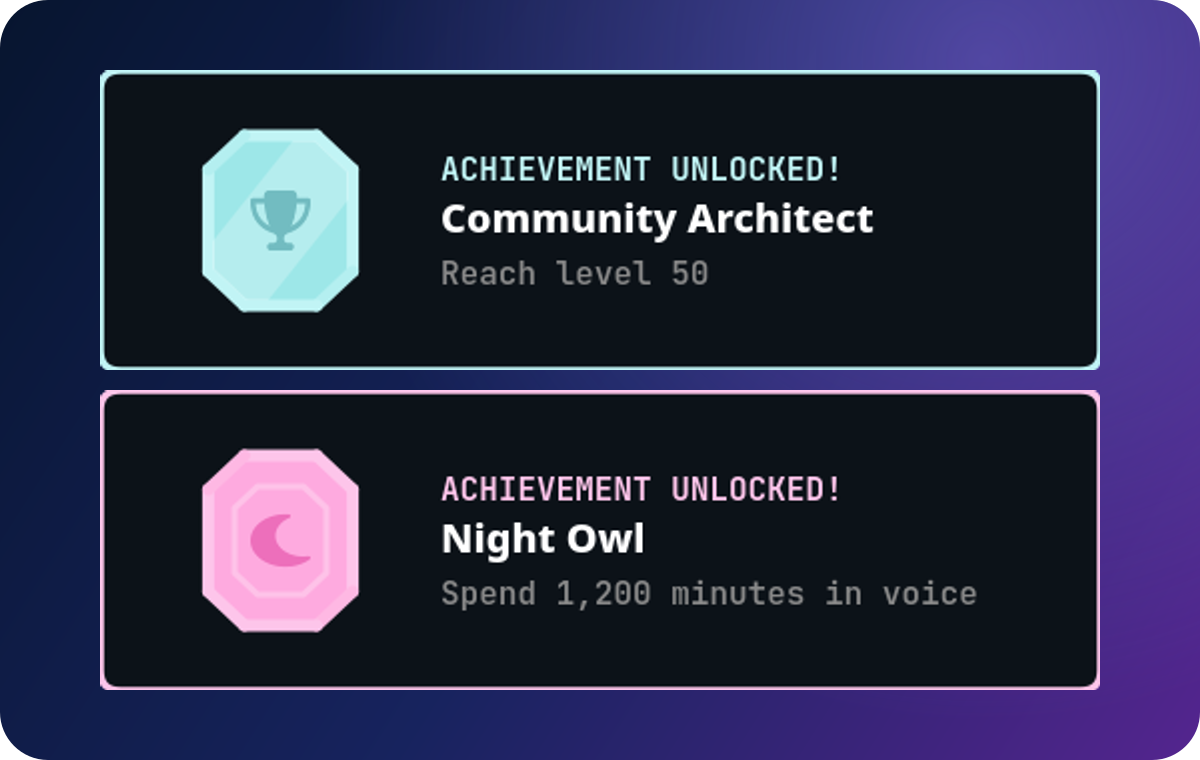
In brief: A Discord achievement is a persistent milestone awarded when a member completes a defined action or reaches a threshold: 1,000 useful messages, 50 eligible voice hours, level 25, a role change, or a community challenge. A good collection tells members what matters here; it does not merely count activity.
What makes an achievement different from XP or a level?
XP is a running measure of progress. A level is a place on that progression curve. An achievement is discrete: it says a particular thing happened. A member can steadily level up while collecting a first event, a helpful-answer, and a long-term voice milestone that each tell a different story.
Use achievements when the accomplishment needs a name, a visible record, or a moment of recognition. Use XP and levels when you want continuous progress. Combining them works best when they do not reward the exact same thing at the exact same threshold.
| System | Answers | Useful example |
|---|---|---|
| XP | How much progress has accumulated? | A member earns points from eligible activity. |
| Level | Where is the member on the curve? | Level 25 unlocks a community role. |
| Achievement | What did the member accomplish? | “First Responder” for 25 helpful reactions. |
how Atom’s Discord leveling system works · the Atom Achievements feature
Build a collection around behaviors, not counters
Start with the behavior you want to make more common. In a study community, that might be sustained focus sessions and helpful citations. In a creator community, it might be attending premieres and making contributions that other members react to. The trigger is an implementation detail; the behavior is the design decision.
A practical first collection has a few early wins, several medium-term milestones, one or two rare markers, and an event or staff-recognized category. This gives newcomers a next step without making long-standing members feel like there is nothing left to earn.
- Use channel-scoped message or reaction milestones where only certain spaces represent the behavior.
- Require eligible voice participation rather than rewarding an empty voice channel.
- Give subjective accomplishments to staff assignment instead of pretending a counter can judge them.
- Retire seasonal cards or make their dates explicit so future members understand their context.
a step-by-step achievement rollout · fair hidden-achievement patterns · anti-farming design guidance
Rarity should communicate difficulty, not decoration
Rarity gives members a shorthand for effort and story. Give your common cards to understandable first actions, reserve the most distinctive visual treatments for genuinely hard or unusual accomplishments, and make the reason for that distinction visible.
Atom supports ten preset card tiers and customizable presentation. A tier should reinforce the status of the achievement; it should not compensate for a vague requirement. A Diamond card for “send 10 messages” teaches members that the system’s signals cannot be trusted.
| Rarity band | Use it for | Avoid |
|---|---|---|
| Common | First-week milestones | Tasks that happen accidentally before a member understands them. |
| Uncommon | Reliable participation | Every small increment of the same counter. |
| Rare | A real streak, challenge, or sustained contribution | Pure luck or opaque moderator preference. |
| Obsidian / Diamond | Signature community moments | Routine activity with a premium skin. |
Make the unlock feel real
The unlock has three jobs: show what happened, tell members why it matters, and point to what is next. A readable title, short description, recognisable icon, and a selective announcement handle the first two. The next step may be another achievement, a role, an event, or simply the member’s continuing level progression.
Atom can announce a generated card and can optionally add or remove XP, levels, and roles after an unlock. Select each reward once, then configure only the amount or roles it needs. Keep rewards proportional. Recognition itself is often enough; a new permission or large XP grant should be reserved for an outcome that changes the member experience.
Launch small, then tune from evidence
Create a controlled test with staff accounts before you announce the collection. Test an eligible action, an excluded action, the exact threshold, announcement delivery, and every configured reward outcome—including XP or level deductions and both role directions. Check the card at the size members will actually see in Discord.
After launch, look for cards that unlock too quickly, never unlock, or reward behavior you no longer value. Disable or revise them before adding more. A collection that remains legible after six months is more valuable than a launch list of 50 almost-identical tasks.
60 achievement ideas with implementation notes · compare current achievement-bot approaches · rebuild an existing collection · create achievements in Atom
Sources and further reading
Where platform behavior or another product matters, verify the current primary documentation before changing a live community configuration.
Build a collection with intent